

The Market is Exploding with Complexity
The market is flooding with point AI tools. Look at the data from AIagentsdirectory.com. In September 2024, they listed 258 AI agents. By December 2025, that number hit 1,921. Nearly 2,000 solutions exist, each with its own data model, security authentication, and logic.
Every department wants one. Sales buys a prospecting bot. HR buys a policy bot. Customer support buys a “smart” chatbot.
This looks like progress. It is actually friction.
Deploying separate agents creates “Agent Sprawl.” You pile up technical debt and slow the business down. Individual agents might speed up atomic tasks, but they slow throughput.
If you are buying dozens of disconnected AI tools that do not talk to each other, you are creating a mess of unmanaged, siloed bots that cannot share context or execute a complete business process.
The Difference Between Tasks and Outcomes
Most AI tools provide tactical efficiency. A chatbot writes an email. A summarizer condenses a meeting. These are atomic tasks. They save a few minutes for one person. Those savings do not hit the bottom line.
They do not transform the business.
Real transformation requires business outcome execution. An outcome is “Onboard a new employee,” “Process an insurance claim,” or “Close a renewal.” These processes touch 20 to 100 systems. They span finance, HR, legal, and IT.
Disconnected agents fail to help the business navigate processes that span departments. A “shipping agent” does not know your billing rules. A “support agent” does not know your inventory levels.
When you deploy fifty different agents, you create fifty new data silos. You force your employees to continue being the integration layer, just like they navigate across apps. They waste time toggling between bots, copy-pasting data, and manually stitching together workflows and prompts.
This destroys productivity. It creates technical debt. It creates security gaps.
The Anti-Pattern: 1,000 Micro-Agents
In software engineering, a design pattern is a proven solution to a common problem. It is a reusable blueprint for building robust, scalable systems. These patterns exist to organize complexity.
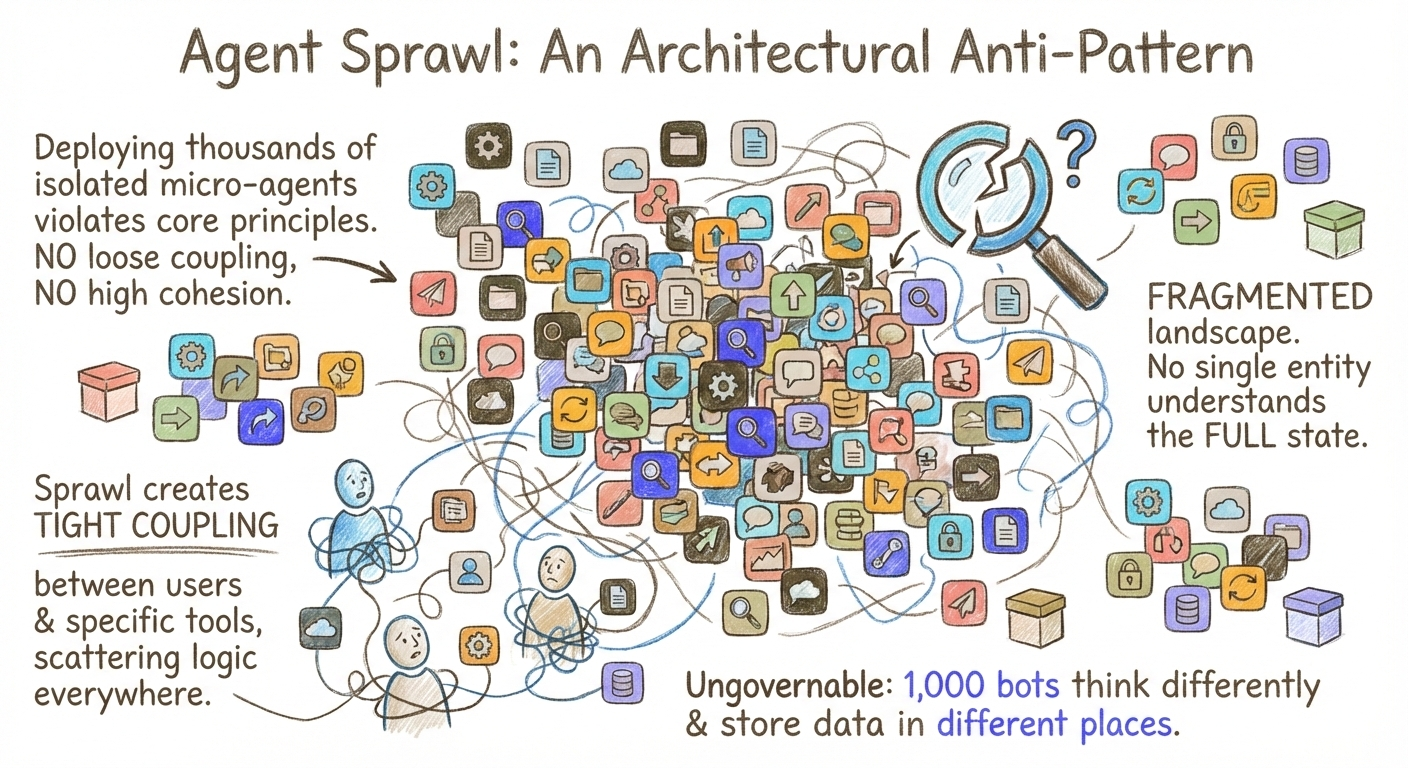 Agent sprawl is the opposite of good design. It is an architectural anti-pattern.
Deploying thousands of isolated micro-agents violates the core principles of software architecture. Good design promotes loose coupling and high cohesion. Sprawl creates tight coupling between users and specific tools while scattering logic across the enterprise. It creates a fragmented landscape in which no single entity understands the full state of the business. You cannot govern 1,000 bots that all think differently and store data in different places.
You need a Conductor.
Think of an orchestra. The musicians play on the same stage. They share the same environment. A hundred musicians playing simultaneously without coordination produce noise, not music. The conductor does not play an instrument. The conductor unifies the ensemble. They ensure every section enters at the right moment, maintains the right tempo, and contributes to a single, cohesive performance.
The Solution: Deploy a Conductor
Krista acts as this conductor. Krista provides a unified platform approach so your automation can share state and work together. This ensures your digital workforce complements your organizational structure, maintains shared context, and reduces management overhead.
Instead of 50 fragmented bots, you deploy:
- One Sales Agent: Equipped with skills for prospecting, pricing, and contracts.
- One HR Agent: Equipped with skills for benefits, payroll, and policies.
 Krista provides an architecture using a proven, scalable design. Do not let agent sprawl drive your strategy. You need a platform that governs, secures, and orchestrates your people, systems, and AI into one unified nervous system.
You need an enterprise brain to bring your people and systems together. You do not need more fragmentation.
Shift your strategy from buying agents to orchestrating outcomes.
For more detailed information on how Krista can orchestrate your business, download our Platform Architecture paper here.
 Building a Cognitive Enterprise Prev post


