
Your employees already send company data to models you do not control. An LLM gateway is how you take that back.
An LLM gateway is the single governed entry point through which every employee prompt reaches every model. It routes each request to the right-sized model, enforces who is allowed to use what, redacts sensitive data before it leaves, caps spend by role, and records every request for audit.
That definition matters because most enterprises already run LLMs at scale without a gateway, and they cannot see any of it.
Shadow AI is already inside the building
By the time a company reaches 1,000 people, its workforce prompts ChatGPT, Claude, and Gemini every day. Some use personal accounts. Some expense a subscription and file it under something else. Many paste customer records, source code, and contract terms into tools no one in IT has reviewed. The industry has a name for this now. Shadow AI.
The capability arrived faster than the controls. Deloitte’s 2026 State of AI reports that 74% of companies plan to deploy autonomous agents within two years, and only 21% say they have the governance to manage them. That mismatch is the whole problem in one line.
Leadership cannot answer four basic questions:
- Which models do employees use, and for what work?
- What does each model cost, by person and by department?
- Has sensitive data left the building, and into whose model?
- Who is allowed to use which model, and does any system enforce it?
A single corporate ChatGPT license does not answer these. It standardizes one tool. It does not route work across models, cap budgets, redact data, or produce an audit trail. It also does nothing about the other tools employees already prefer.
An LLM gateway is how you close it.
Two products share the name. Only one governs the enterprise.
Search the term and you find two different things wearing one label.
The first is a developer proxy. Tools like OpenRouter, LiteLLM, and Portkey unify many models behind one API. They add failover, some spend tracking, and a per-token markup. Engineers wire them into applications. They are useful, and they govern nothing about people.
The second is an enterprise access gateway. It sits in front of the workforce, not the codebase. Every employee prompt flows through one governed surface. The gateway reads the prompt, applies the company’s policy, routes the work, and records the result. The employee still gets an answer. The company gets control.
What a real LLM gateway has to do
Four jobs separate a governed gateway from a pipe to a model.
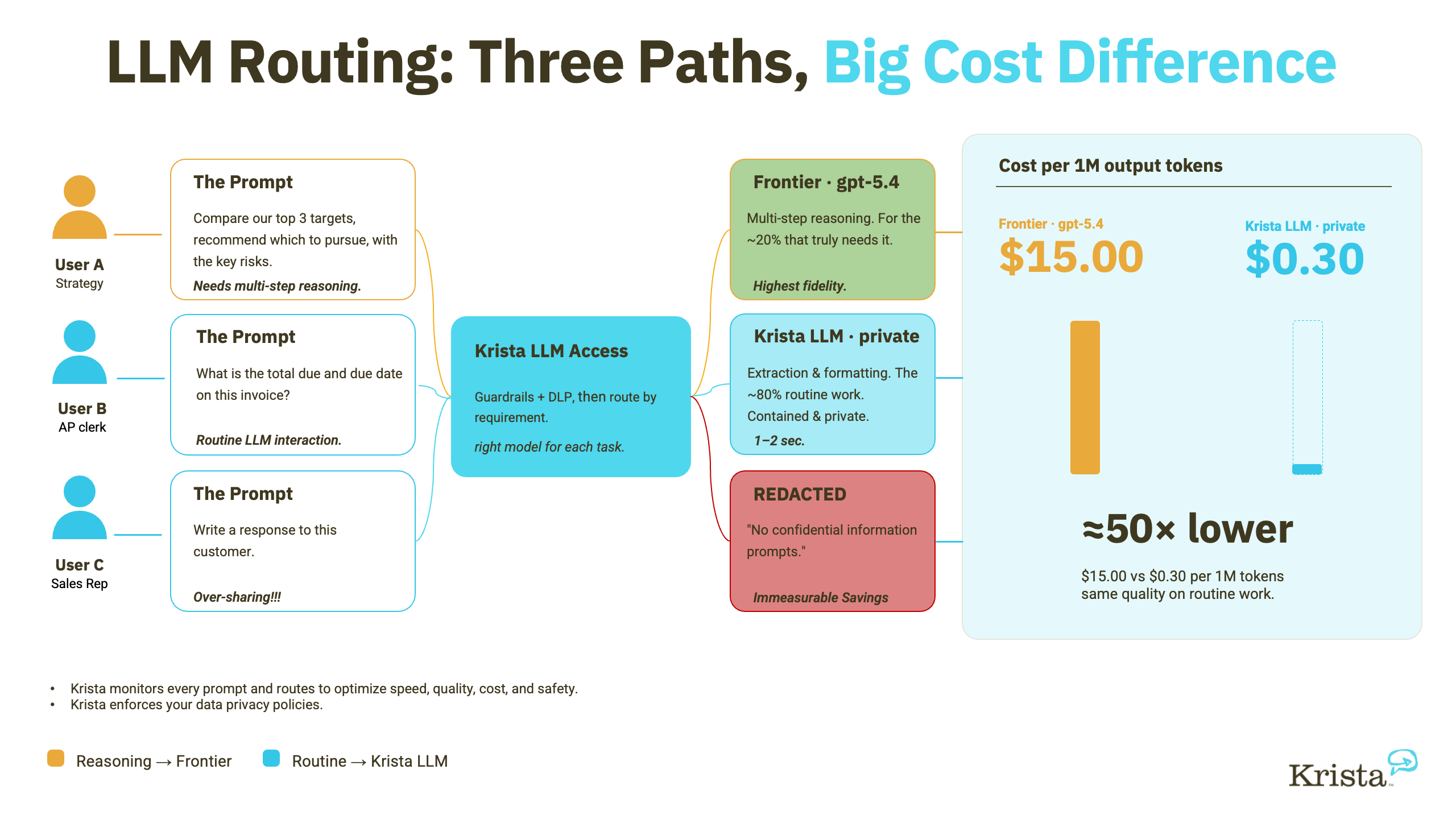
Route every prompt to the right-sized model. Most platforms default to one expensive flagship model for every task. That habit produces Token Waste, the economic equivalent of using a supercar to deliver mail across the street. A gateway reads each prompt and sends it to the model that fits the work on cost, speed, accuracy, and safety. Roughly 80% of enterprise work runs at near-parity on an inexpensive model: routine extraction, classification, and standard question answering. The 20% that needs frontier reasoning routes to a premium model. Krista runs routine work on her own model at about $0.30 per million tokens against roughly $15.00 for a flagship model. On the majority of the load, that approaches a 50x difference.
Stop sensitive data before it leaves. A gateway inspects both prompt content and destination. When a prompt carries a launch code, a patient record, or a credit card number, the gateway redacts the value before the request leaves. The model returns a useful answer and never sees the real data. Public models stay locked down while private and self-hosted models stay open, because a prompt sent to a contained model never leaves the instance.
Govern who does what, by role. Policy runs in the path of every prompt and takes one of three actions. Block a forbidden topic like an acquisition rumor before it leaves the building. Warn on a sensitive area like the internal roadmap. Redact a specific value and let the rest of the prompt through. Each rule attaches to a role, so a research lead and an entry-level analyst do not get the same reach.
Cap spend and prove it. Budgets attach to roles and departments. As a budget fills, the gateway steps work down to cheaper models instead of slamming a hard cutoff. Every request, the policy decision, the model used, the tokens consumed, and the cost land in an immutable log. Finance reads the same line items it expects from a cloud bill.
Read those four jobs again. They are not four products bolted together. They are one control layer that acts on the request while it is happening.
What it looks like in practice
An accounts-payable clerk pastes an invoice image and asks for the total and the due date. Routine work. The gateway routes it to an inexpensive model and returns the structured result. Cost, a fraction of a cent.
A strategy analyst asks the same gateway to reason through a market-entry scenario. The gateway routes that prompt to a frontier model, where the premium earns its price.
A support rep pastes a customer email that contains a full credit card number. The gateway redacts the number before the prompt leaves, answers the question, and logs the event. The card never reaches an outside model.
Same governed surface. Three different outcomes. One audit trail underneath all of them.
A dashboard is not a gateway
New tools now promise to help with AI cost. Most of them watch. They connect to your provider accounts, total the bill, and flag a spike after it happens. Visibility is useful. Visibility is not control.
A dashboard tells you the bill is too high. It cannot make the bill lower, because it sits downstream of the request, reading a number someone already spent. A gateway sits at the request, where the spend, the data exposure, and the policy get decided. One reports. The other acts.
The same logic runs through everything Krista builds. GenAI generates text. Krista generates outcomes. Monitoring the bill is a report. Governing the request is an outcome. Risk is not an afterthought bolted onto AI. It is the reflex built into the platform.
Where to start
An enterprise does not rebuild anything to put a gateway in front of its models. The Krista LLM Access Gateway installs on top of the models and systems you already run. She blocks direct, ungoverned access to public models and gives employees a governed prompt surface inside the firewall instead. Behind that surface, Krista routes each prompt, applies your policy by role, and records every token and dollar.
The gateway is also how the Enterprise Brain governs its own reach. A brain that remembers, reasons, and acts across your systems needs one disciplined door to the models it runs on, not a thousand personal accounts.
The fastest way to see the cost side is to run your own numbers. The LLM cost calculator compares frontier-only spend against routed spend and shows your monthly and annual savings in about two minutes.
Then take one question into any vendor selling you an AI cost tool. When my employee pastes a customer record into a public model, does your product stop it, or does it only tell me later what it cost?