
I lead product strategy here at Krista. A few customers asked me to evaluate a new product idea, the kind of question that normally eats three weeks of analyst time. I wrote a single prompt instead.
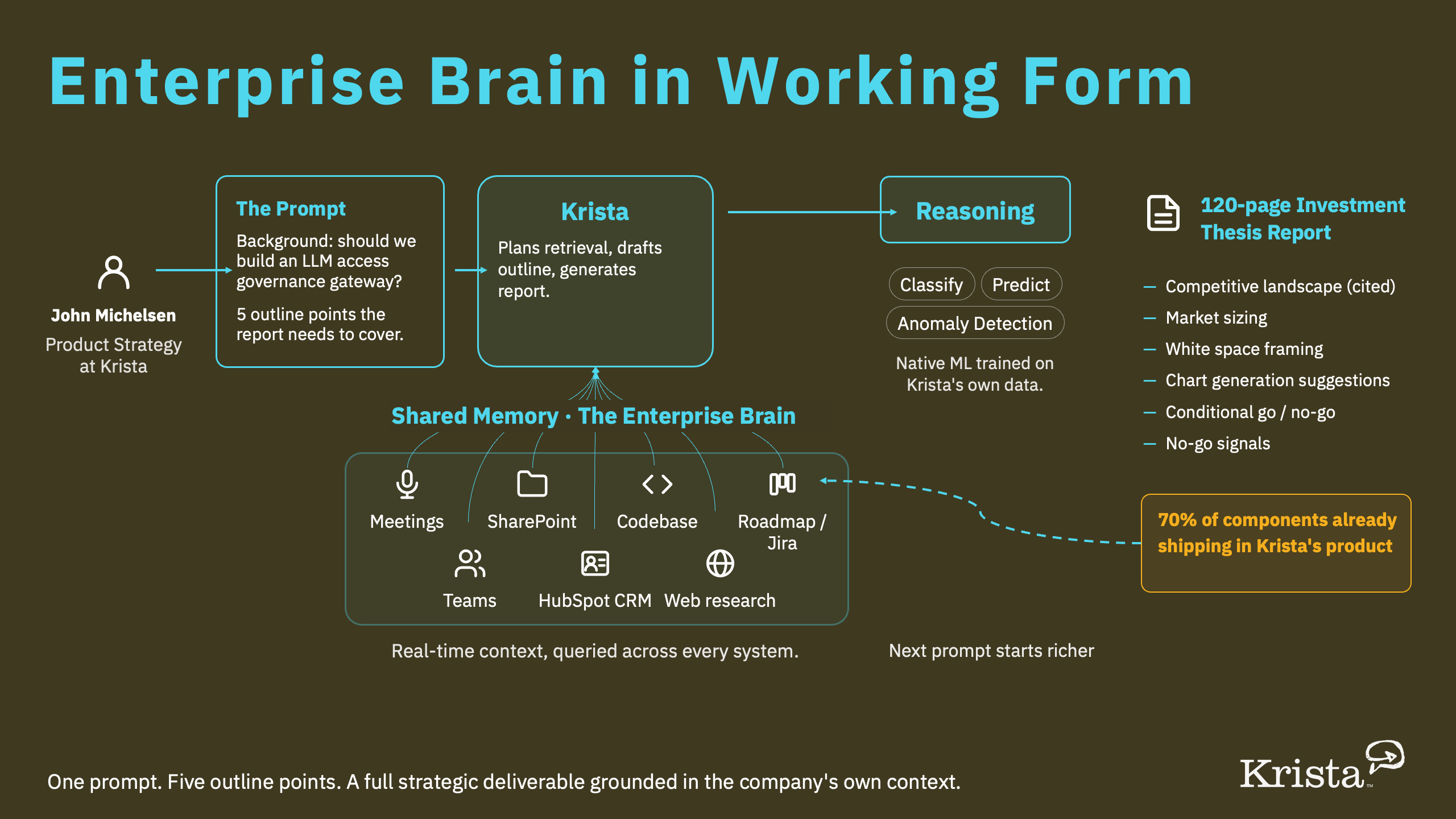
What came back named the competitive landscape, the white space, market sizing, the go and no-go conditions, and charted options worth visualizing in a final investment thesis report. Most important, it included the one line no generic AI tool could have produced:
“I found 70% of the components of the system already in our product.”
That is not a search result. That is institutional knowledge surfacing on demand. That is the Enterprise Brain in working form.
The prompt I gave our Reporting Agent
I typed the background in plain English:
“I’ve heard one too many customers and partners ask us to provide a solution to managing the LLM access of their employees in the organization. I keep recommending [a certain product] and everybody keeps saying it sucks. So now what? We need to think about this. Do we want to get into this business?”
I added five outline points the document needed to cover. I hit run.
The customer ask itself was a Krista-fronted LLM access and governance gateway. A way for an enterprise to block direct access to Gemini, Claude, and OpenAI while still giving employees a governed prompt surface inside the firewall. The kind of bet that needs market context, competitive context, and a build estimate before it leaves the room.
What came back
Krista produced a cited competitive landscape. Beyond [that other product]. The cloud scalers. OpenAI and Anthropic. The framing of where white space exists and where it does not.
Krista offered chart generation suggestions throughout the document. Click the button and Krista renders the visual on the spot. Skip it and the prose stands on its own. The agent does not burn compute on speculative image generation. It surfaces the chart where the analysis would benefit and waits for me to choose.
Krista wrote the go and no-go section directly. A conditional go based on named levers and engineering capacity. The no-go signals listed alongside, so leadership could see the conditions that would kill the bet before the company invested in it.
Then Krista delivered the 70% number.
Why a generic LLM cannot do this
I could have prompted Claude. I could have prompted Gemini. I could have opened ChatGPT. I did not. I chose Krista’s reporting agent for one reason.
Krista knows the company.
A generic LLM has no memory of Krista. It does not know the happenings in our thousands of meetings over the years. It cannot read the Jira ticket backlog. It has no idea what is on the roadmap or what shipped last sprint. Ask it to size a new product and it writes some words but not the answer.
Krista’s reporting agent draws from a shared memory that connects our meetings, conversations, SharePoint documents, code, and product plans into one source of truth. The same memory the company runs on every day. The memory that knew we already had 70% of the proposed product, because it had heard the engineering team build the underlying components in roadmap meetings and watched them ship in past releases.
The takeaway
What I got back is a good example of what the Enterprise Brain can accomplish. One prompt. Five outline points. A full strategic deliverable with cited competition, recommended visuals, a conditional go decision, and a build estimate that started from what the company already owned.
The companies that build their brain can exploit this capability for every product question, every market question, and every operational call. The companies that stack generic AI tools on top of disconnected systems get the opposite: A bot that speaks fluent English yet knows nothing about the business. How can you go agentic if the AI doesn’t know you?
Krista builds the brain. Then the brain answers the questions only the brain can answer.
