

A retail electricity provider lost power across its service area. Calls flooded in. Krista routed 12,000 inbound customer calls through an AI voice agent in a five-hour window.
The contact center industry scales one way: hire more people, forecast volume, staff weeks in advance, hope the forecast holds.
Grid failures do not respect forecasts.
The Staffing Math Does Not Work
You cannot spin up 150 trained agents in five hours. You cannot park them on payroll waiting for an outage that may never come. Traditional call centers facing this volume produce hour-long holds, dropped calls, and customers who churn.
The AI voice agent answered every call.
Concurrency Is the Real Test
Total call volume is a vanity metric. Concurrency is the engineering metric. The question is how many active conversations the platform runs at the same second.
The math on this deployment:
- 12,000 calls in 5 hours
- 2,400 calls per hour
- 40 calls per minute
- ~120 simultaneous conversations at a 3-minute average handle time
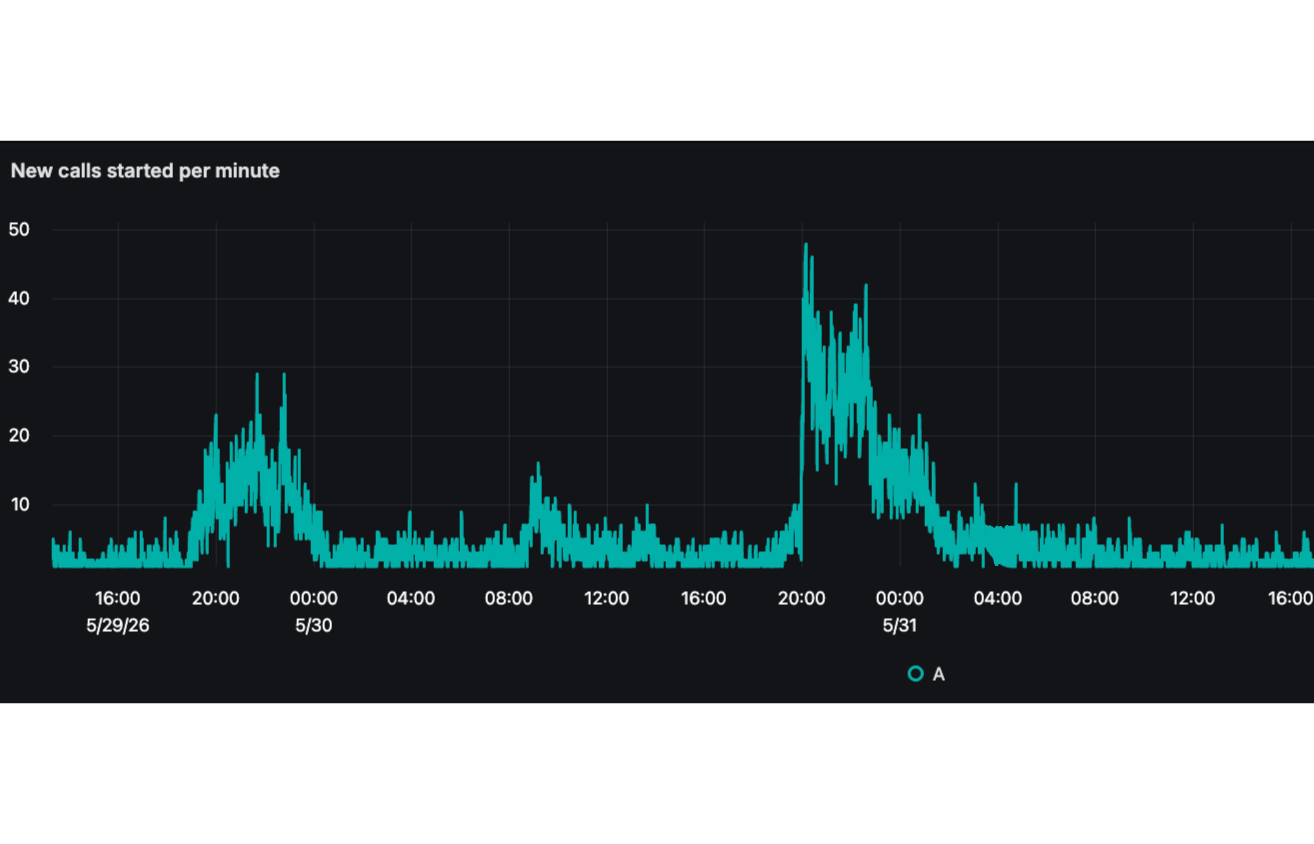
Entry-level voice AI platforms cap standard users between 5 and 30 concurrent calls. Synthflow starts at 5 on pay-as-you-go. Vapi defaults to 10. Bland’s free tier includes 10. Retell includes 20. Past 100 concurrent connections, you need enterprise infrastructure.
Three Things Break at 120 Concurrent
Latency. Under light load, a voice agent holds sub-700ms response times without effort. Push it to 120 simultaneous inferences and latency drifts. Past 1.2 seconds, the caller talks over the agent. Past 2 seconds, the caller hangs up.
Integration handoffs. The model rarely fails first. The CRM does. Push 12,000 outage dispositions over five hours and the API hits rate limits. Without flawless queuing, the audit trail breaks.
Orchestration. At 120 concurrent, the AI is not a tool. It conducts SIP trunking, real-time grid status lookups, intent classification, and backend writes in lockstep. One dropped beat costs a call.
The Economics
Industry benchmarks place a fully-loaded human call between $6 and $12. Handling 12,000 of them costs $72,000 to $144,000, assuming you could staff for it. You cannot.
Voice AI agents run roughly $0.06 to $0.15 per minute. Twelve thousand calls at three minutes each costs $2,160 to $5,400.
The savings is a footnote. The point is that the work got done.
Voice AI as Infrastructure
Most teams treat voice AI as a customer service feature. At 120 concurrent during a regional grid failure, it stops being a feature. It becomes infrastructure.
That is the difference between a chatbot and an enterprise brain. A chatbot answers a call. A brain orchestrates a crisis. Krista runs the orchestration layer that turns spike traffic, telephony, CRM writes, and grid lookups into one coordinated workflow.
Stop scaling humans against forecasts you cannot trust. Start orchestrating outcomes. → krista.ai


